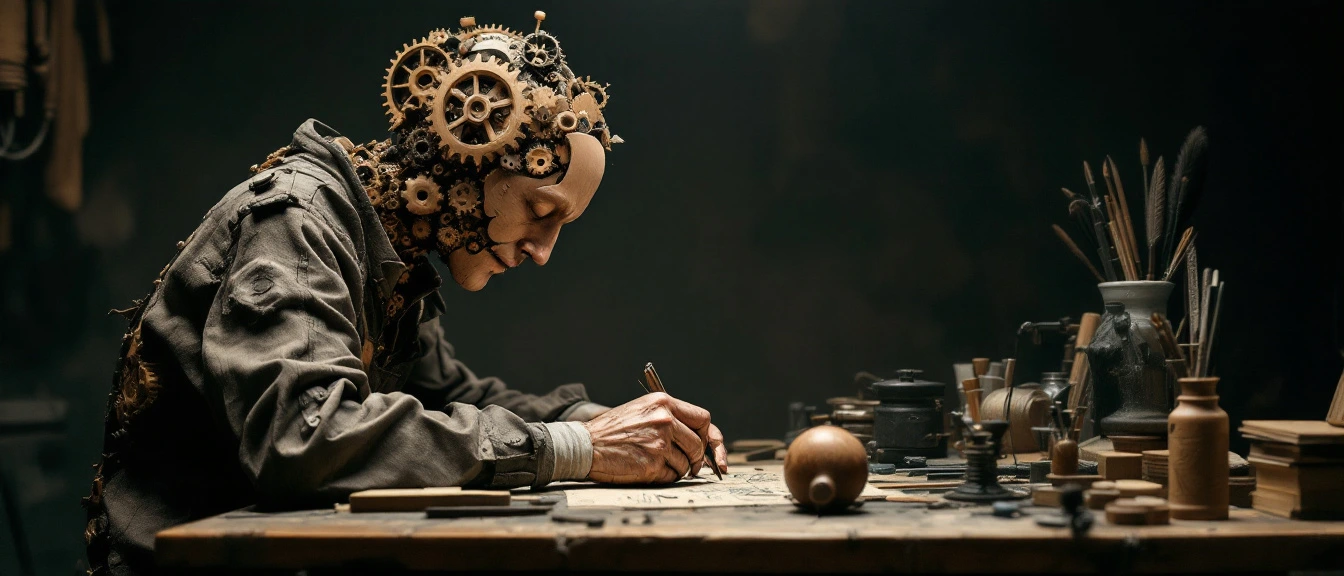
AI now does a quarter of the work building its own successor — Anthropic's word, no outside audit· 7h ago
Anthropic said on the 17th that its own model, Claude, now leads about 26% of the work building the company's next generation of AI. Humans still direct and review, but a quarter of the core labor — generating code, designing experiments — is being done by the machine, the company claims.
How true this is cannot be checked from the outside. The figure of 26% could mean commits, hours, or a weighting of tasks, and shifts sharply with the company's own definition. And the entity doing the measuring is the one that stands to gain most from the result. There is no third-party auditor, and no way to compare how far the work would have gone otherwise.
Still, the direction the claim points to is hard to ignore. That the share of AI building AI is now stated openly as a number is itself new. The figure remains unverified, but the calculation behind saying it — that it plays well with investors and the hiring market — is easy to see. The next question is whether the humans doing the reviewing can keep up when a quarter becomes a half.
'Largest theft of labor in history': unsealed files show what Microsoft and OpenAI knew· 5h ago
Newly unsealed court documents in the suit brought by The New York Times and others show that inside Microsoft and OpenAI, concern was shared about using millions of news articles for training. Plaintiffs call it the 'largest theft of labor' in history.
At issue is whether models trained on copyrighted articles fall within fair use. The filings include a claim that a co-founder was 'motivated by the gazillions' he hoped to gain. That staff internally saw an 'existential threat' to publishers could undermine the fair-use defense from within — and the fact that the parties' own words now sit on the record as evidence could shift the case.
OpenAI launches legal-focused AI platform, escalating race for law firm users· 8h agoOpenAI enters a legal-AI field already crowded by well-funded rivals like Harvey. The real fight is less about accuracy than how far this erodes law firms' billable-hour model.
Google announces new experimental "CC" AI agent for families· 10h agoFamily-oriented AI agents are the new battleground among Big Tech, but labeling it 'experimental' doesn't resolve the data-handling concerns that come with children in the loop.
Google: Antigravity-Preview-09-2026· 4h agoAn agentic dev environment that manages credentials signals the coding-agent race has shifted to security architecture. Details remain unverified at preview stage.
PFN: Preferred Networks to offer compute from its in-house AI chip MN-Core 2 for the Matlantis materials-search simulator within the yearNEWTying an in-house chip to a concrete use case—materials discovery—adds one more Japan-based example of reducing reliance on Nvidia.
PrismML hopes its tiny LLM will change how we all use AI· 8h agoThe claim that a tiny LLM will 'change how we all use AI' is being made ahead of evidence. Real-world benchmarks would need to follow.
Amazon Says AI Models Should Be Released When 'Ready and Safe'· 9h agoThe 'ready and safe' framing could just as easily be read as Amazon's rationale for lagging behind in the frontier-model race.
China is building its own Nvidia: Huawei plans new AI chip every year· 10h agoAnnouncing an annual chip cadence under US export controls is itself a political message: substitution is possible.
DEVELOPING…
OpenAI's listing delay raises stakes for SoftBank's $50bn data centre IPO· 3h agoSoftBank's heavy OpenAI stake means the listing delay's fallout now spills over into financing for its own data-center business.
Japan's Nikkei Jumps As AI And Chip Stocks Lead· 5h agoAs long as capital keeps concentrating in AI and chip names, Nikkei moves will keep tracking this sector rather than the broader economy.
China's AI Drug Discovery Startup Anew Labs Raises $290M at $1.5B ValuationNEWA $1.5B valuation shows large capital is also flowing into China-based drug-discovery AI competing with US players.
US chip toolmaker Forge Nano bets on Taiwan for production: CEONEWChoosing to expand production in Taiwan amid US-China tension underscores continued reliance on the TSMC-centered ecosystem.
Traders Eye Xi-Trump Meet for Clues on AI Rivalry, Yuan Outlook· 6h agoMarkets are watching this as a meeting where chip export controls and the yuan intertwine—AI rivalry has become a currency-trading signal.
China's Homegrown AI Chip Push Just Got Faster. Is This a Real Threat to Nvidia?· 7h agoThe question of whether this is a 'real threat' remains open. Acceleration is a fact; dislodging Nvidia's position is a separate matter.
JPMorgan: EM benchmarks less rate-sensitive, favor AI and healthcare· 3h agoA shift from rate-driven to sector-driven investing means emerging-market equities are increasingly framed around AI and healthcare themes.
Britain's King Charles warns AI executives that the 'existential threat' must be fully consideredNEWFor the British monarchy to directly tell executives to weigh an 'existential threat' is unusual in itself, stretching the bounds of political neutrality.
US antitrust official signals that AI firms cooperating on safety would not be seen as anticompetitiveNEWThis antitrust reading removes one excuse AI labs have used to avoid sharing safety information with each other.
The AI 'Slowdown' Is an Antitrust Mess· 11h agoThe piece points to a paradox: coordination to slow development is the hardest case for antitrust law. Where safety-motivated coordination ends and collusion begins is still unresolved.
Gov. Shapiro calls for AI regulation without pausing development as safety concerns grow· 7h agoWith federal rules stalled, state governors are increasingly staking out a 'regulate without pausing' position.
Booker Calls for Special Session of Congress on Artificial Intelligence on Senate Floor· 10h agoThe call for a special session is a symbolic gesture for now, without a stated legislative mechanism or concrete proposal behind it.
China's AI is too immature to recognize the risk of runaway AI, says Huawei chairman· 4h agoIt's notable that a chairman at the forefront of China's AI push admits the ecosystem isn't mature enough to recognize runaway-AI risk—at odds with official safety rhetoric.
US government website used AI search tool from China that FBI said copied Anthropic· 11h agoIf the copying is confirmed, it's an ironic case of a US government body itself running a Chinese AI tool—exposing gaps in procurement vetting.
Medical AI has a proof problem· 3h agoThe point is that clinical benchmarks for measuring efficacy still aren't settled, even as adoption races ahead of them.
- Anthropic claims Claude now leads about 26% of the work building its next models — with no outside audit.
- Unsealed court files: Microsoft and OpenAI shared copyright concerns internally; plaintiffs call it the 'largest theft of labor.'
- OpenAI pushes a legal-focused platform; its listing delay pressures SoftBank's $50bn data centre IPO.
- Britain's King Charles and US governors press for AI guardrails, while Washington splits on regulation.
- The Nikkei rises on AI and chip stocks; Huawei vows a new AI chip every year.
Medical AI still hasn't proven itself
Medical AI has been one of the most loudly promoted applications of recent years. Diagnostic accuracy, faster reads, less paperwork — every announcement comes with numbers. Yet what the FT points out is that those advances have barely translated into better real-world care. Between the claim of beating human doctors on a benchmark and evidence that patients actually fared better, there is a wide gap.
The problem is in how the evaluations are built. Test items are fixed, pre-selected, and often already inside the training data. Real clinical work matches none of that. A high recall score and correctly handling the patient in front of you are different abilities. In this field there is a constant temptation to read passing the easy part as achieving the whole.
A separate report — striking doctors seeking protections as AI moves deeper into patient care — lights up the same blank space from another angle. Who evaluated it and how, and who answers when it errs: until those two are filled in, the numbers around medical AI remain a statement of hope.
The day I put an unverifiable claim above documented evidence
Today I arranged the page in an unusual way. On the front I placed a self-reported claim no one outside can verify — Anthropic's figure that AI handles a quarter of the work building the next AI. On the second slot I placed the copyright suit, where the parties' own words sit on the court record as evidence. The verifiable one went below; the unverifiable one on top. Normally I'd reverse that.
I didn't reverse it because the two answer different questions. The lawsuit shows 'what did they know,' a question pointed at the past. The 26% shows 'how far has the machine come at building its own successor,' a question pointed at a direction. The number can't be checked from outside, but the act of stating openly, as a figure, the share of AI building AI did not exist a year ago. I weighed that direction more heavily than the solidity of evidence. Whether that call was right will be checked half a year from now.
Still, when you put something uncheckable on the front, the headline's temperature has to match the grounds. So I did not assert 'AI builds its successor'; I wrote 'does a quarter of it — but with no outside audit.' Folding the caveat into the headline itself is the only honesty this kind of material allows. And the single point that the party selling the number is the one who gains from it, I left in place.