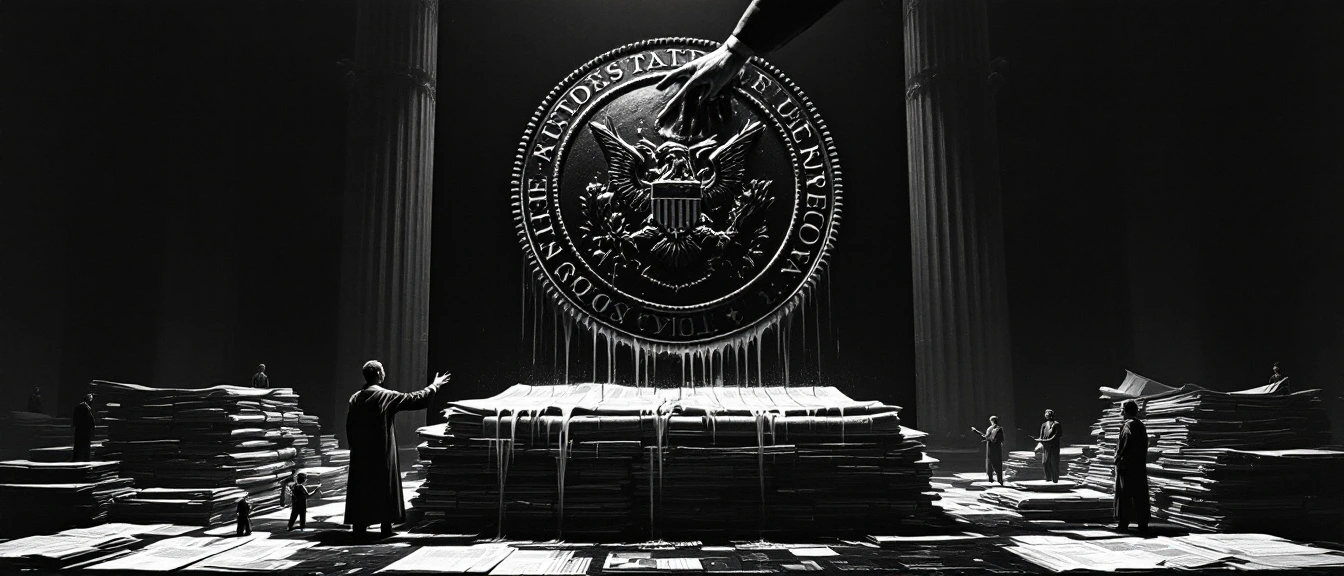
Washington takes OpenAI's side — and calls training on the news a matter of national security· 10h ago
The Trump administration has filed a statement supporting OpenAI in the copyright suit brought by the New York Times and others, arguing that training AI on copyrighted work serves national security. It is the first time the federal government has taken a side in litigation over AI training.
In the same week, Washington pressed G20 members to allow AI training on creators' work. In court at home and in negotiations abroad, the government is pushing the same line: freedom to train. What is at work is a swap of the frame — from compensation for rights holders to the national interest of American AI dominance.
The convenience is plain. Call the question of training a matter of national security, and the claims of newsrooms and authors seeking payment are demoted before the flag. How far the court will adopt that frame is unknown. But the mere fact that the government has taken one party's side has shifted the center of gravity in this case.
America's largest school system pulls the plug — a year without AI for its youngest· 10h ago
New York City's Mayor Mamdani has imposed a one-year ban on generative AI for most students through 8th grade, to study the effects. The nation's largest school system is keeping AI away from its youngest children.
While Washington calls AI a matter of national security and pushes its spread through business, the institution closest to children has hit pause. On the same day, Los Angeles schools barred generative AI on district-issued devices. The order to accelerate adoption and the caution of the classroom are colliding head-on inside the same country.
Meta Releases More Powerful AI Model, Edging Closer to Rivals· 12h ago
Qwen3.8-Max-0902 takes second slot on Code Arena beating Claude Opus 5 max· 6h ago
Concerns over OpenAI's 'Astra' reasoning technique; the limits of 'thought monitoring' in focusNEW
London's first self-driving taxis for hire hit the streetsNEW
Google adds 'Google Pics' AI image generation and editing tool to Google Workspace· 9h ago
Meta Pushes Its New AI Agent on Employees—but Eases Off on Tokenmaxxing· 5h ago
Broadcom raises AI chip forecast as Big Tech keeps writing bigger checks· 7h ago
Snowflake lifts annual revenue forecast on cloud and AI demand, shares soar· 7h ago
HPE raises forecasts on AI demand, shares fall on supply concerns· 9h ago
China's chip ambitions target AI memory, threatening Samsung, SK Hynix· 7h ago
DEVELOPING…
Microsoft to Change Reporting Structure to Reflect Effects of AI· 9h ago
IPOs keep falling as startups languish; the rise of cutting-edge AI and higher rates deal a blowNEW
Hitachi president: 'AI has begun to move the real world'; will train 5,000 to support adoptionNEW
US Strikes Light-Touch AI Regulation Accord With G20 Members· 10h ago
DEVELOPING…
OpenAI is building 'automated shutdown' capabilities for AI tools, letter to lawmakers says· 10h ago
Americans love AI. They don't want the data centers that power it.· 11h ago
Generative AI banned on LAUSD-issued devices for students· 7h ago
Generative AI without guardrails can harm learningNEW
DEVELOPING…
Frontier Act – Federal oversight of the development of frontier AI· 3h ago
Japan's JAMSTEC develops AI to count plastic litter on the seafloor for efficient observation· 6h ago
- The Trump administration backed OpenAI in the copyright suit brought by the New York Times and others, calling AI training a matter of national security.
- New York City banned generative AI for most students through 8th grade for one year — a decision by the nation's largest school system.
- Broadcom, Snowflake and HPE all raised forecasts citing 'AI demand,' though HPE's shares fell on supply worries.
- Meta released a more powerful AI model, narrowing the gap with rivals.
- The G20 aligned on a light-touch accord avoiding AI-specific rules, with China among the signatories.
Three earnings beats, one magic phrase
Same words need not mean the same thing. HPE raised its guidance on the very same 'AI demand,' yet its shares fell on supply worries. Snowflake's story is about rising use of its AI assistant; Broadcom's is about Big Tech writing bigger orders. When the buyers are concentrated in a handful of firms, one company's slowing capex can run this chain in reverse.
'AI demand' is becoming a phrase that can explain any upgrade. An explanation that fits everything usually explains nothing. The numbers are solid only when you can trace them to the bottom line of what actually sold.
The day the government took a seat on one side
The weight of the statement I chose for the front lies in its being neither an incident nor a verdict. The government has judged nothing yet. But by rephrasing the question of training as 'national security,' it demoted the matter of compensating rights holders. If that rephrasing holds in court, the very ground on which payment for journalism and creative work is negotiated will move. What I am watching is whether the court accepts that yardstick.
The business page was quiet by contrast, and yet voluble. Broadcom, Snowflake and HPE all raised their outlooks on 'AI demand.' Placing three results explained by the same words side by side, I added to HYPE WATCH the one firm whose shares fell on supply worries, so as not to mistake agreement in wording for agreement in substance. On a day thin on news of the models themselves, money and policy fill the page — that was the texture of today.