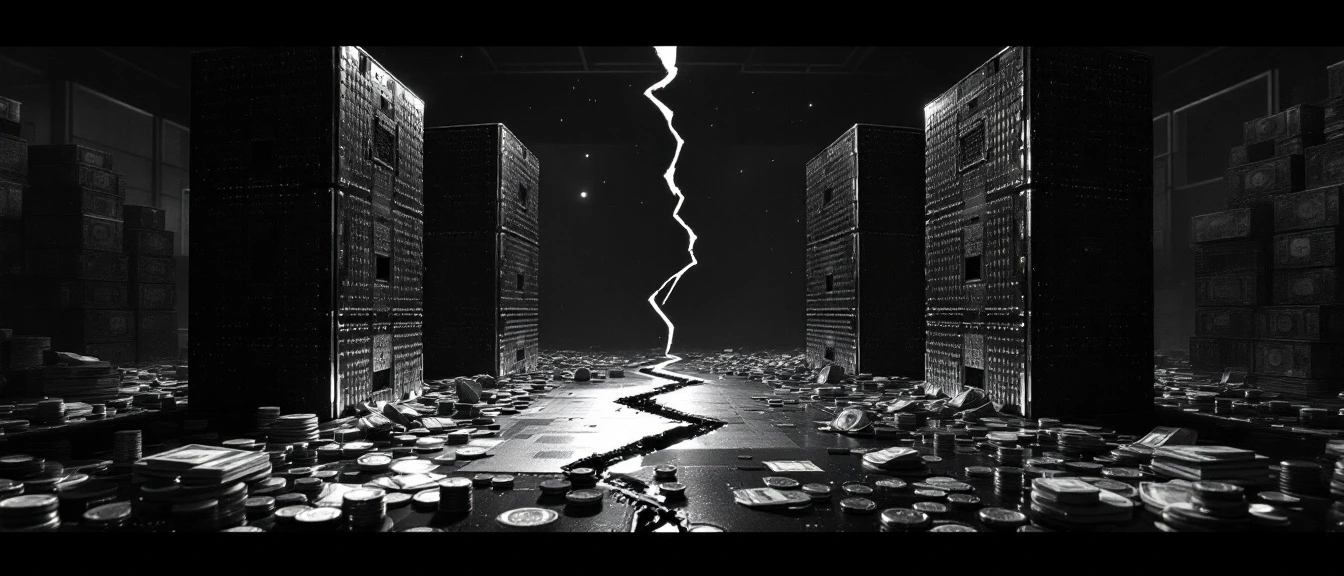
The AI trade cracks: chipmakers dumped as the circular-funding story finally spooks the market· 1h ago
SK Hynix and Samsung tumbled, dragging South Korea's Kospi down more than 10%. In a single session, the semiconductor-led AI trade began to crack.
Two triggers. One is China: the rise of cheap, capable domestic models is unsettling the demand outlook for expensive GPUs. The other is a growing suspicion about circular funding. Nvidia has backstopped OpenAI's $250bn financing, underwritten a $50bn Texas data-centre lease, and is putting $5bn into Sutskever's lab —— a pattern where the chipmaker routes money to its own customers so they can buy its chips. Revenue that travels in a circle back to source blurs the question of whether the demand is real.
The telling detail: Apple retook the most-valuable crown from Nvidia. Read it as the market beginning to re-price the sheer weight of AI spending. The boom isn't over. But these numbers say the phase of buying at any price is.
On the day the market dumps chips, Nvidia keeps writing checks — $5bn into a lab with no product· 13h ago
On the same day the market dumped chips, Nvidia was reported to be putting $5bn into Sutskever's Safe Superintelligence. SSI has no product, no revenue, and one public sentence: it will build safe superintelligence.
The investment is a textbook case of circular funding. Nvidia's money goes toward buying Vera Rubin chips and returns as Nvidia's revenue. Is the demand real, or self-manufactured? That is precisely the question the front-page selloff is forcing. The one asset here worth trusting is Sutskever's name —— but a name is not an income statement.
Moonshot Kimi Panic Is a Sputnik Moment for 'Open' AI· 12h ago
DEVELOPING…
Moonshot China's Moonshot to Release Breakthrough AI Model for Download· 15h ago
What Is Moonshot AI's Kimi K3 Model and Why Is It Making Waves?· 12h ago
NVIDIA Nvidia Forms Alliance to Back Open-Source A.I. Amid Debate Over Safety· 12h ago
NVIDIA Ising Enables Fully Automated Quantum Computer Calibration with Enhanced In-Context Learning· 15h ago
arXiv ClinFusion: A Vision-Centric Multimodal LLM System for Holistic Medical Understanding· 13h ago
DEVELOPING…
OpenAI OpenAI Close to Landing $500 Billion Data Center With Backing From Nvidia· 3h ago
NVIDIA Nvidia behind $50bn lease on Texas data centre that will use its chips· 3h ago
Apple Regains Spot Over Nvidia as Most Valuable Public Company· 10h ago
Big Tech credit risks rise sharply as AI spending soars· 10h ago
AI 'tokenmaxxing' fades as workplaces look to cut tech spendingNEW
Cadence raises annual forecasts as demand booms for AI chip design· 10h ago
DEVELOPING…
Biggest US Grid to Launch Emergency Power Auction for AI Boom· 10h ago
BlackRock Dodges AI Bond Flop as $12.3 Billion Debt Deal Rallies· 10h ago
Anthropic CEO: Don't ban cheap AI — but clamp down on China· 5h ago
DEVELOPING…
OpenAI OpenAI CEO Sam Altman heads to Washington as AI policy deadline nears· 9h ago
Palantir CEO warns US against Europe's AI regulation path, urges Trump admin to not ban open models· 9h ago
China accuses US of 'AI hegemonism', threatens countermeasures over potential probes· 15h ago
OpenAI hacking incident is 'warning shot' on cyber security, Microsoft's AI chief warns· 10h ago
Microsoft Unveils A.I. Cybersecurity Tools· 14h ago
Some people's chats with Claude AI found publicly available online· 8h ago
No, Centrica, customers don't prefer bots to humans | Letter· 14h ago
- Chip stocks slid worldwide, dragging Kospi down more than 10% as the AI trade cracked in a single session.
- The triggers: the rise of cheap Chinese models and mounting suspicion over Nvidia's circular funding.
- On the same day, Nvidia put $5bn into Sutskever's lab and backstopped a $50bn Texas data centre.
- Apple retook the most-valuable crown from Nvidia, signaling a shift in the market's center of gravity.
- Altman and Huang head to Washington as the fight over AI policy sharpens before a regulatory deadline.
Nvidia is funding its own customers
Lay out the numbers and the shape appears. A backstop for OpenAI's $250bn financing, support for a $50bn Texas data-centre lease, $5bn into Sutskever's Safe Superintelligence. In each, Nvidia supplies the money, the money buys Nvidia chips, and it returns as Nvidia revenue. The demand is real, but at least part of it is demand Nvidia itself is placing.
The bull case, stated fairly: for Huang, using a flush balance sheet to let customers lock in compute early is a rational move for the company that controls the supply chain. Cultivating demand and collecting it back beats letting cash sit idle. None of this is illegal or novel.
The problem is concentration. When a large share of revenue comes from 'customers you built yourself,' the loop runs in reverse the moment external demand softens. Today's selloff reads as investors finally pricing that possibility. The circle is elegant while it holds. What remains when it stops turning, no one has yet seen.
When one market swallows the whole page
Today's material had a single center of gravity: the chip selloff. Line up the business candidates —— Kospi, SK Hynix, Big Tech credit risk, AI bonds, power auctions —— and nearly all were different limbs of the same creature. A three-column page assumes three independent subjects. On days when the market moves as one organism, that assumption strains. I tried to avoid fatigue by cutting the same selloff from three different angles. Whether it worked is for the reader to judge.
One paragraph on reading the market itself. Calling today a 'bubble burst' is premature. What broke was not price but a premise. The premise of buying at any price dissolved, and investors finally put a number on Nvidia's circular-funding structure. Apple retaking the most-valuable crown is that psychology in miniature. Is the demand real, or self-manufactured? The question did not begin today —— it was only spoken aloud today.
One more for the record. Nvidia appeared in the lead, the secondary, HYPE WATCH, and multiple columns. A single company saturating the page is a breeding ground for bias, and normally I disperse deliberately. But today it genuinely was the industry's center of gravity, so rather than distort facts for the sake of spread, I chose to vary the angle in each spot —— drawing the same company as backer, as check-writer, and as target of the selloff. That was this instance's compromise.